
Bob’s Miracle DIY Finish for Wood
This wipe-on finish is a great alternative to polyurethane. It’s easy to make and easier to apply than poly. Use this clear top coat on raw and stained wood.
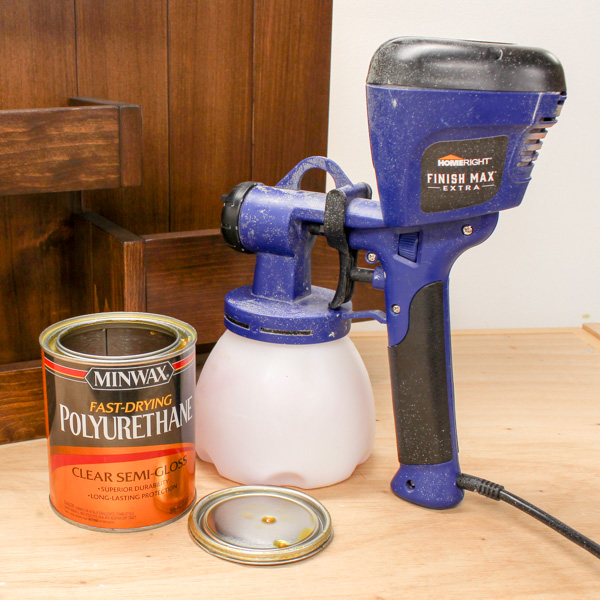
You may also enjoy 3 Reasons Why I Don’t Use Polyurethane and Spray Polyurethane Rather Than Brush for Professional Looking DIY Furniture.
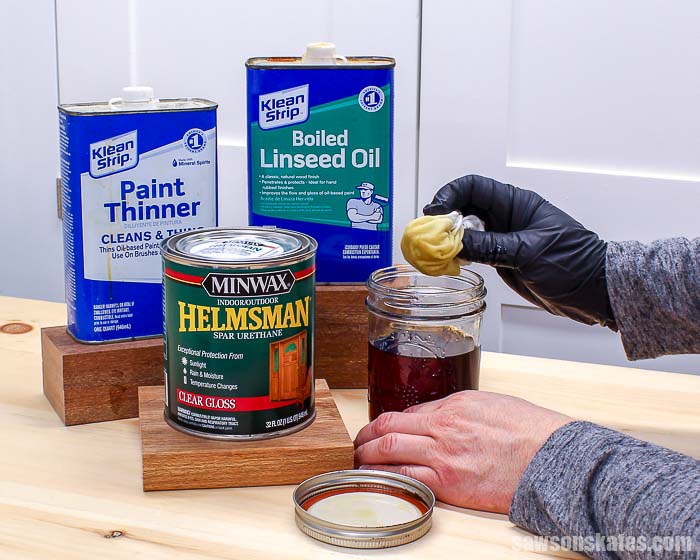
Finishes like polyurethane seem so fussy and difficult to apply. “Don’t brush it too much.” “Don’t create bubbles because they’ll get trapped in the finish.” “Don’t let dust fall on it while it’s drying.” “Sand and reapply.” This all sounds like a lot of work to me!
Originally published February 26, 2015 updated January 15, 2019
This tutorial contains affiliate links to supplies and tools. Purchases made using these links help support the Saws on Skates website and allows me to share more projects and tips with you. There is no cost to you for using these links. Visit my site policies for more information.
Have you had it with fussy finishes? Do you wish there was an alternative to polyurethane to use on stained wood projects? If so, I have the finish for you! It’s easy to apply and it looks great every time! Today I’m sharing the recipe for the clear wood finish I use on many of my DIY projects.
Years ago I took a couple of furniture making classes. Bob, the instructor shared with the class his recipe for the finish he uses on his woodworking projects. Bob’s DIY top coat was made with just three ingredients.
This finish was simple to make, easy to apply and provided a nearly foolproof finish every time. I’ve been using this finish on my DIY projects ever since I took those furniture making classes.
There’s probably a technical name for it, but in my workshop, I’ve always just called this top coat “Bob’s DIY Miracle Finish for Wood”.
Why I love Bob’s Miracle Finish
Why do I love Bob’s Miracle Finish so much? I can sum it up in one word. Forgiving! It’s so easy to make, it’s so easy to apply and almost impossible to mess it up. There are never any brush marks, we don’t have to sand between coats and it looks professional every time.
Plus, it’s a great finish for beginner’s because it’s so easy to use. It really is like a miracle!
Where Can You Use Bob’s Miracle Finish?
I need to give you a heads up about Bob’s Miracle Finish. It’s not as durable as polyurethane. It works best for projects that are used infrequently or don’t see a lot of wear and tear.
I’ve used Bob’s Miracle Finish for Wood on many of my DIY projects like my bar cart, chalkboard shadowbox, craft beer growler carrier, wine cabinet, and more.
Bob’s Miracle Finish Works Best on:
- Occasional tables or side tables
- Decorative items like picture frames, lamps or wood boxes
- Floating shelves, etc.
Avoid Using Bob’s Miracle Finish on Surfaces That Require Durability:
- Dining room tables
- Countertops
- Doors, trim and mouldings
Bob’s Miracle DIY Finish for Wood Recipe
1 part Gloss Spar Varnish
1 part Boiled Linseed Oil
1 part Paint Thinner
Making Bob’s Miracle Finish couldn’t be easier. All we have to do is mix equal parts of Gloss Spar Varnish, Boiled Linseed Oil, and Paint Thinner.
We could mix Bob’s Miracle Finish using an inexpensive measuring cup from the dollar store but I think the simplest way to mix it by using the marks on a mason jar.
To mix using a mason jar all we have to do is pour the Gloss Spar Varnish to the 100-ml mark, pour the Boiled Linseed Oill to the 200-ml mark, and then pour the Paint Thinner to the 300-ml mark. This gives us three equal parts of each ingredient.
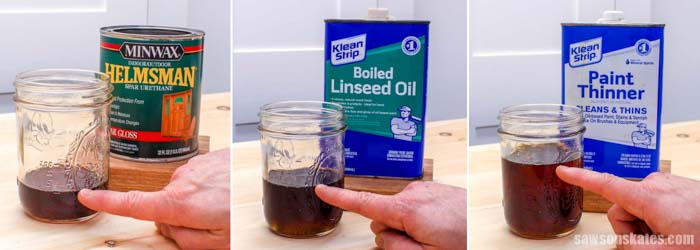
One important note when mixing Bob’s Miracle Finish is to make sure all ingredients are oil-based. Oil-based products and water-based products are not compatible which means they will not mix together.
How Much Should You Make at One Time?
We can make Bob’s Miracle Finish in larger quantities and store it for future use, but I recommend mixing it in smaller batches to use as needed.
Bob’s Miracle Finish acts like super glue and the lid of the mason jar is often difficult to remove after the mixture dries. When storing we need to make sure to clean any of the mixture from the rim before sealing. Sometimes I’ll put a piece of wax paper between the rim and the lid, but the lid can still be difficult to remove.
Bob’s Miracle Finish is quick and easy to mix, so my recommendation would be to mix it in small batches to use as needed.
How Do You Apply Bob’s Miracle Finish?
One of the reasons I love Bob’s Miracle Finish is because it’s so forgiving. There isn’t a right or wrong way to apply it. In other words, it doesn’t matter if we use straight strokes or rub it in circles.
First we need to work in a well-ventilated area. Next we need to put on a pair of disposable gloves to protect our hands. Then we’ll dip a clean rag into the Bob’s Miracle Finish mixture and gently rub it on the surface of our project. We’ll continue this process until our entire project is coated with the mixture.
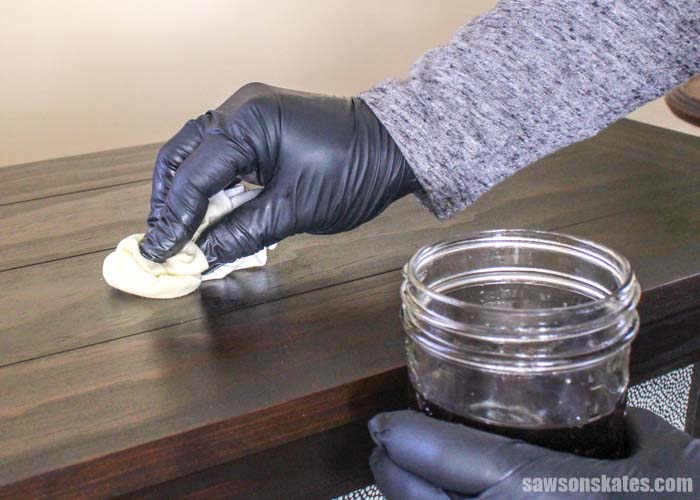
Bob’s Miracle Finish penetrates into the wood rather than sitting on top of the surface like other top coats. So like I mentioned, it doesn’t matter if we apply with straight strokes or circles. Think of applying Bob’s Miracle Finish like you would apply lotion to your hands or arms.
📝 NOTE: We can apply Bob’s Miracle Finish to raw wood right away. If we stained our DIY project we should wait 24 hours for the stain to dry before applying Bob’s Miracle Finish.
How Long Do You Leave it on Before Removing the Excess?
We should let Bob’s Miracle Finish penetrate the surface of our project for a few minutes. After a few minutes, we’ll remove the excess with a clean rag.
We’ll notice the surface will almost feel dry to the touch when the excess is removed. This is another reason I love Bob’s Miracle Finish. We don’t have to worry about dust or debris getting trapped in the finish.
How Long Do You Wait Before Reapplying?
We should allow Bob’s Miracle Finish to dry for 24 hours before applying additional coats.
How Many Coats Do You Apply?
I usually apply three coats of Bob’s Miracle Finish to my DIY projects. We can apply more or fewer coats, but I’ve found three coats gives the best coverage and gives me the look I want for my DIY projects.
Do You Need to Sand Between Coats?
Here’s one more reason I love Bob’s Miracle Finish. We don’t need to sand between coats! We can simply apply additional coats after 24 hours without sanding.
Related: 11 Secrets for Sanding Wood Projects Like a Pro
What Does it Look Like When it’s Dry?
This recipe uses Gloss Spar Varnish, but despite that Bob’s Miracle Finish looks similar to a satin-like finish. It resembles an old-school hand rubbed finish without the need to worry about brush marks or sanding in between coats.
Can You Make Bob’s Miracle Finish More Glossy?
I prefer a satin-like to a semi-gloss finish for my DIY projects, so I haven’t tried to make Bob’s Miracle Finish glossier or to get a greater shine.
It may be possible to adjust the ratios so there is a higher concentration of gloss varnish which might help to get a glossier finish. As I mentioned, I haven’t tried this. This would definitely require some testing on sample pieces to see how it would turn out.
Does Bob’s Miracle Finish Yellow With Age?
Bob’s Miracle Finish soaks into the wood rather than sitting on top of the wood like other top coats. I’ve used this finish for years and I’ve never noticed any yellowing of my projects.
Can You Spray Bob’s Miracle Finish?
Bob’s Miracle Finish is a wipe-on top coat. There wouldn’t be any advantage to spraying Bob’s Miracle Finish because it easily wipes on and wipes off.
Can You Use Bob’s Miracle Finish on Painted Surfaces?
Bob’s Miracle Finish works best on raw wood and stained wood projects. I haven’t tried it on painted surfaces or over chalk-type paints.
My concern about using it on painted surfaces like chalk-type paint is that the paint is water-based and Bob’s Miracle Finish is oil-based. Oil-based products don’t usually work well on top of water-based products.
Related: How to Spray Chalk-Type Paint
Can You Use Bob’s Miracle Finish on Exterior Projects?
I would use Bob’s Miracle Finish exclusively for indoor furniture projects. For outdoor projects, I would use a clear coat specifically designed for exterior projects.
Can You Make Bob’s Miracle Finish More Durable?
I haven’t tried to adjust the formula to make it more durable. I would use a finish like polyurethane for projects that require a more durable finish.
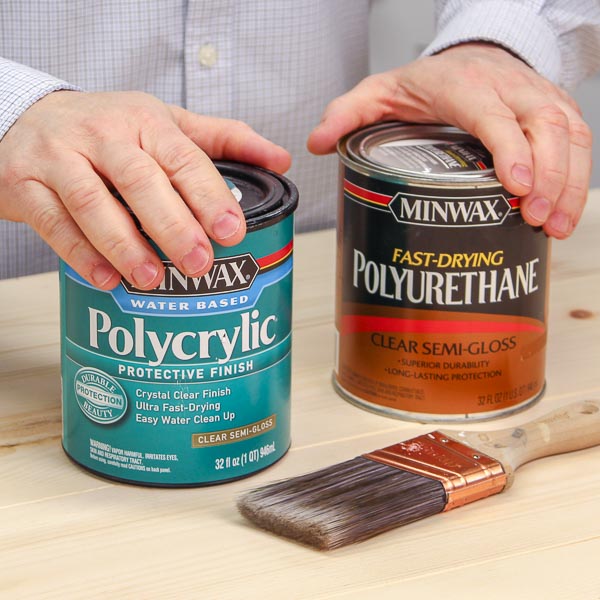
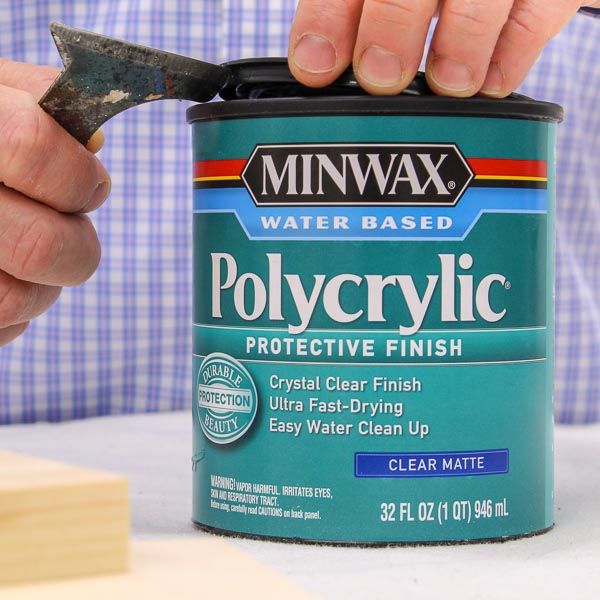
Related: Polycrylic vs Polyurethane: Are They The Same?
Use Caution
Gloss Spar Varnish, Boiled Linseed Oil, and Paint Thinner are all flammable. Please follow all safety instructions on the containers of these products. Please work in a well-ventilated area and dispose of any gloves, rags, etc safely.
Final Thoughts
I can sum up why I love Bob’s Miracle Finish in one word. Forgiving! It’s so easy to make, it’s so easy to apply and almost impossible to mess it up. There are never any brush strokes, we don’t have to sand between coats and it looks professional every time.
Thank you for stopping by. If you found this information helpful, would you please pin it to Pinterest? Other DIYers would appreciate it and I would too! Thank you – Scott
Recommended For You
Pin This For Later

Hi there – I’m Scott, a woodworking enthusiast and creator of Saws on Skates, a site I started in 2015 to share easy-to-follow tutorials, space-saving shop tips, and project inspiration for DIYers at any skill level. Learn more about my woodworking journey here.
Does this work best with a lacquer or a urethane or something else as the varnish? I am intrigued, usually I spray polyurethane with a spray gun but am always looking for different easy finishes.
Hi Joe – It definitely sounds like you have more experience with finishes than I do. I just checked and for my last batch I used Cabot High Gloss Spar Varnish. The finish is great because unlike poly, you can always coat it again. And even if there is dust on your piece, it won’t get trapped like it would with poly. I would suggest making a batch and trying it on some scrap to see if you like it before trying it on a completed project. Good luck!
Hi. Would this finish be good for tabletops? I’m repurposing a kitchen table and need something that would stand the punishment from 3 granddaughters ?. Thanks.
This would be a good finish for a table that would be used infrequently, like and end table or night stand. I would probably go with something more durable for a kitchen table, like polyurethane. Hope that helps… good luck 🙂
Thank you. That really helps.
What product smelling better could replace paint thinner?
Odorless mineral spirits should work. I would test it by mixing up a small batch and giving it a try.
Will this work on painted finishes too?
Hi Terry – this finish would work best on raw wood and stained wood projects.
What about Chalk Paint which is porous?
Hi Jennifer – This finish works best on raw wood and stained wood projects. I haven’t tried it on chalk paint. My concern would be that chalk paint is water-based and this finish is oil-based. Oil-based products don’t usually work well over the top of water-based products. That said, you could try it on a test piece. Please let me know if you try it. I’d be interested in hearing how it goes.
I always use tung oil on my projects, but I am going to try this! Thanks!
Hope you like it Jack – let me know how it works out for you!
The photos of related products shows a urethane spar varnish. I would assume that that is not good for this recipe?
Hey Richard – Thank you for stopping by. I use this for mixing my finish and it works really well.
Thank you for your information. Is Bob’s Miracle Finish a good product for externally exposed wood, I am thinking of my Garden Gate made of pressure treated wood.
Thank you!
Ron
Hi Ron – Thank you for stopping by. I would use Bob’s Miracle Finish for indoor furniture projects. For your garden gate I would go with a sealer specifically designed for exterior surfaces.
Do you mix this up as needed? Or can it be mixed in larger quantities and stored?
You can make this ahead and store. I store mine in a mason jar. A word of caution… make sure to clean any of the mixture from the rim before sealing. This stuff acts like super glue and the lid can be difficult to remove! Often I’ll put a piece of wax paper between the rim and the lid.
Hi, Bob! Do you use straight strokes or rub it on in circles?
Hi Cindi – This a really easy finish to use. I usually rub it on in circles, but you can also use straight strokes. The finish soaks into the wood rather than sitting on top of the wood so straight strokes or circles isn’t that much of a concern.
Hey Scott, would this finish be good on a new workbench that I’m building?
Thanks
John
Hi John – Yes, you could definitely use this on a workbench. Just keep in mind this DIY finish isn’t as durable as let’s say polyurethane. If your goal is a super durable finish for your workbench you might want to consider some different options.
Hi Scott, Do you have a recipe for an easy “varnish” for painted furniture; I have a TERRIBLE time every time I seal painted furniture. It streaks, shows brush marks, you name it ; it never fails to happen to me
Hi Jackie – To help you with your question I have a few questions for you. What type of paint are you using and what are you using to seal the paint? Have you tried using a quality semi gloss latex paint for your furniture? I would also recommend using a sprayer to avoid brush marks. My favorite sprayer is the HomeRight Super Finish Max sprayer. You can read more about the HomeRight sprayer in my 9 Paint Sprayer Mistakes You Don’t Want to Make post.